
Installation
Installation
For Home owners
Condominiums, Common Garage and Electricians, please see further down
In case you live outside of Norway you can order a charger with a red plug or a charger for fixed installation as use of industrial plugs for charging is legal for fixed installation by example in Sweden.
In case you live in Norway and will use the charger in a private house or cottage you need to order a charger for fixed installation.
We have several agreaments with electricians that will install our charger for a fixed price of 6 900.- NOK inclusive MVA on the following terms:
The following is included:
- A maximum of 10 meters of cabling from the main fuse box to where the charger shall be placed
- New dedicated 32A line in the main fuse box with ground error breaker
- Connect the connector box where the charger shall be placed
- Making up to 2 holes in wood and materials
- Documentation
- Up to 50 km driving to and from
The following may come in addition:
- More than 10 meter of cabling
- Over voltage protection in case you dont have this from before in your fusebox
- Digging for underground cabling
- Hideen cabling inside walls
- Making more than 2 holes holes and holes in concrete
In case you live in Oslo or close to Oslo you can contact Moderne Elektro, https://moderneelektro.no/ on phone +47 22 12 01 05 or send them an email on firmapost@moderneelektro.no.
In case you live in Horten or Porsgrunn you can contact Haneseth El-Installasjon AS, https://www.haneseth.no/haneseth-el-installasjon,on phone +47 917 18 189 or send them an email on horten@haneseth.no
In case you live in Bø, Notodden or Seljord you can contact Elektropluss Telemark AS, https://www.elektroplusstelemark.no/ on phone +47 909 84 587 or by email on: gs@elektroplusstelemark.no
The charger you can just order from us, and hang up on the wall yourself. The metal plate that comes with the charger is easy to screw up on the wall and then you just hang the charger on the metal plate. The electrician must connect the chargers connector box. Further information is found in the manual that comes with the charger.
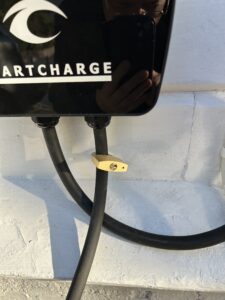
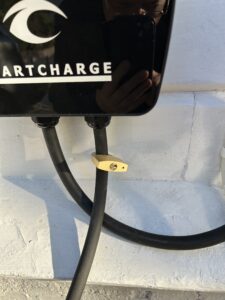
In case the charger is hanging outside and you are afraid that someone will steal it you can screw a ring eyed screw in the wall and use a lock to fasten the charging wire to the screw like the image below shows.
Common Garage
Our charger is ideal for common garages. The garage management can have connector box and the affordable back plates installed on all parking lots in the garage. Then the car owners can order chargers themself directly from our shop when they will need a charger. The charger is easy to hang up on the back plate. There is only one screw to fasten the charger. Then an electrician need to connect the charger to the connector box.
A main user needs to be responsible for all chargers in the garage. This user will add all chargers in the app and make them available for all persons that shall be allowed to use that charger. When you shall buy a charger for a common garage you will order our charger for fixed installations.
Our charger supports load balancing in the between the chargers so that everyone can charge maximum on the available electricity. This can be enabled by adding the loadbalancer produkt to all chargers. The main user will have detailed overview over how much every charger in the garage has charged.
For Electricians
The charger has embedded RCD 30 mA AC and 6mA DC protection so only a normal fuse with ground error breaker is needed in the fuse box. In private homes we recommend to always cable for 3 phases from the fuse box to the charger as Tesla supports 3 phase charging on both IT and TN net and in the future more brands are expected to support this.
In common garages you can either install a separate cable to each charger or you can use a heavier cable and add a 32A fuse breaker with ground error deduction and connector box next to each charger. The electrician can order the affordable back plates and install them so that user can buy chargers and hang them up themself when they will need a charger. The electrician must connect the charger to the fuse box. We recommend to rotate between the cabling so that L1, L2 and L3 is connected to L1 on every 3rd socket as most of the cars have only one onboard converter and therefore only charges on one phase.